Sermon Outline Template: 5 Structures Every Pastor Should Know
Stop starting from a blank page every week. These 5 proven frameworks — with fill-in-the-blank templates and real examples — will cut your prep time and sharpen your preaching.
 Jake Thornhill·11 min read·June 14, 2026
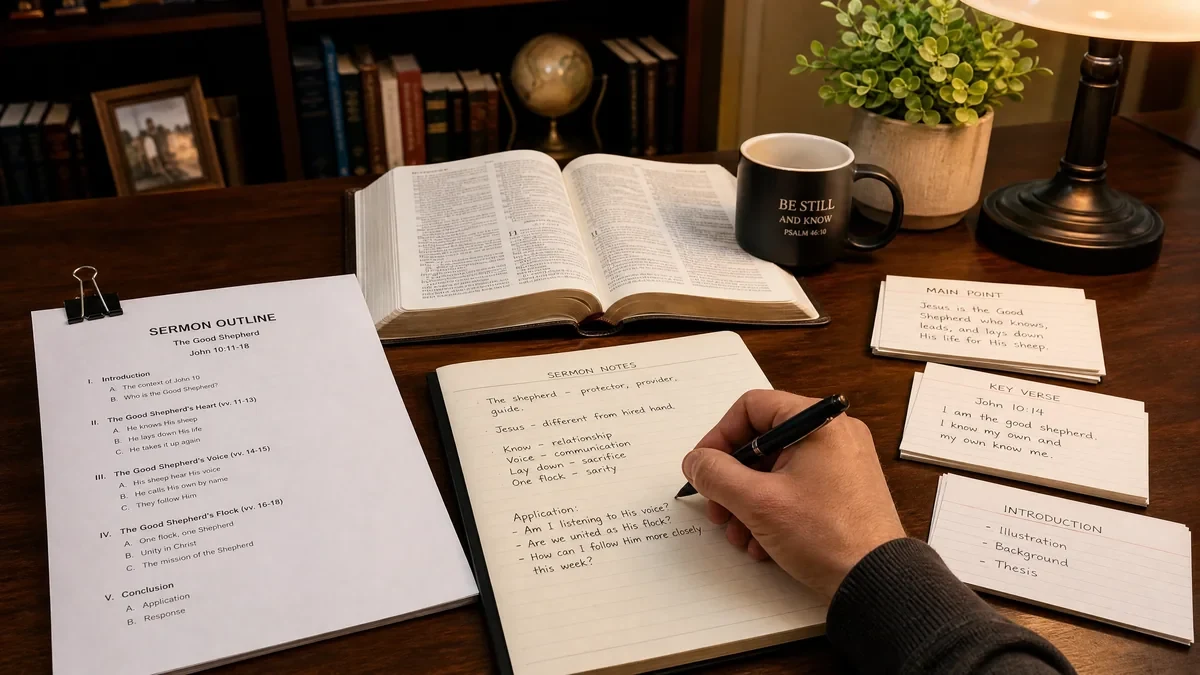
TL;DR
The five sermon outline templates every pastor should know are: expository, topical, narrative, problem-solution, and textual. Each serves a different text type and congregation. Knowing which to use — and having a fill-in-the-blank framework ready — can cut your outline time from 3-4 hours to under 90 minutes.
Two ways to save hours every week:
Senior Pastor AI Prompt Pack
$6.99 · one-time
8 AI Agents for Ministry
$97/mo · or $997/year
Why Your Outline Structure Matters More Than You Think
Most pastors spend 10-15 hours every week preparing a single sermon. A significant portion of that time is spent staring at a blank page — not because they don't know their text, but because they don't have a reliable structure to pour their content into. According to Barna Research, sermon preparation consistently ranks as one of the top weekly time demands for pastors — and the blank-page problem is one of the most commonly cited frustrations.
The outline is not the sermon. But it is the skeleton that holds everything together. A weak outline produces a wandering message. A strong outline produces a message that builds, lands, and sticks with people long after Sunday morning.
Here is what most preaching classes don't teach clearly enough: different texts require different structures. Preaching an expository outline through a narrative passage is like putting a square peg in a round hole — technically possible, but awkward for both preacher and congregation. The five templates in this post match the right structure to the right text type, every time.
Once you understand all five, you will be able to look at any text and immediately know which structure will serve it best. That single skill can cut your outline time by 40-60%. If you want to go deeper on cutting total prep time, read our guide on how to reduce sermon prep time without sacrificing quality. For AI-specific tools that work with these templates, see our AI sermon outline generator roundup.
Template 1: The Expository Outline
The expository outline is the most common structure in evangelical preaching. It works through a specific text sequentially, letting the passage's own structure drive the sermon's structure. Every main point comes directly from the text — not from a topic you bring to the text.
Best for: Verse-by-verse teaching series, epistles, wisdom literature, and any text where the author's argument is the sermon's argument. If you are preaching through Romans, Philippians, or Proverbs, expository is almost always the right choice.
The discipline of expository preaching forces you to let the text set the agenda. You cannot avoid the hard passages. You cannot skip the uncomfortable applications. That accountability to the text is one of the reasons expository preaching tends to produce the deepest long-term discipleship growth in a congregation.
Fill-in-the-Blank Framework
Title: [Main theme from text]
Text: [Scripture reference]
Big Idea: [One sentence that captures the text's main point]
Introduction: [Hook → Bridge to text → Preview of Big Idea]
Point 1: [From verse/section 1] — [What it says] → [What it means] → [How it applies]
Point 2: [From verse/section 2] — [What it says] → [What it means] → [How it applies]
Point 3: [From verse/section 3] — [What it says] → [What it means] → [How it applies]
Conclusion: [Restate Big Idea] → [Call to response] → [Closing image or prayer]
Example: Philippians 4:4-7
Big Idea: Peace is not the absence of anxiety — it is the presence of God in the middle of it.
Point 1 (v.4): Rejoice always — not because circumstances are good, but because God is.
Point 2 (v.5-6): Replace worry with prayer — the specific practice Paul prescribes.
Point 3 (v.7): Receive the peace that "surpasses understanding" — what God promises in return.
One practical tip: before you build your expository outline, write your Big Idea in one sentence. If you cannot summarize the text's main point in a single sentence, you do not yet understand the text well enough to preach it. The Big Idea is your compass — it determines which details make it into the sermon and which ones stay in your notes.
Template 2: The Topical Outline
The topical outline starts with a theme or question and gathers supporting texts from across Scripture. The sermon's structure is driven by the topic, not by a single passage. Each point addresses a different dimension of the topic.
Best for: Felt-need series, seasonal messages (Christmas, Easter, Mother's Day), doctrinal teaching, and topics where the full counsel of Scripture is needed to give a complete answer. Topical preaching is also effective for outreach-focused series where you want to meet people where they are before bringing them to the text.
The risk with topical preaching is proof-texting — pulling verses out of context to support a predetermined conclusion. Guard against this by reading each supporting passage in its full context before using it, and by letting the texts shape your points rather than forcing the texts to fit points you already decided on.
Fill-in-the-Blank Framework
Title: [Topic as a question or statement]
Central Question: [The one question your sermon answers]
Big Idea: [Your answer to the central question]
Introduction: [Establish why this topic matters to your congregation right now]
Point 1: [First dimension of the topic] — [Supporting text] → [Explanation] → [Application]
Point 2: [Second dimension of the topic] — [Supporting text] → [Explanation] → [Application]
Point 3: [Third dimension of the topic] — [Supporting text] → [Explanation] → [Application]
Conclusion: [Bring all three dimensions together] → [Call to response]
Example: "What Does the Bible Say About Anxiety?"
Central Question: How does God want me to handle anxiety?
Point 1: God acknowledges your anxiety is real (Psalm 55:22 — cast your burden).
Point 2: God gives you a practice to replace it (Philippians 4:6-7 — prayer with thanksgiving).
Point 3: God promises a peace that doesn't make sense (Isaiah 26:3 — perfect peace for fixed minds).
Template 3: The Narrative (Story) Outline
The narrative outline follows the arc of a story — tension, complication, resolution. Instead of points, it has "moves" that follow the story's natural progression. The application emerges from the story rather than being stated as a separate point.
Best for: Old Testament narratives, Gospel stories, parables, and any text that is structured as a story. Also effective for biographical series (David, Paul, Esther) and for congregations that respond better to story than to didactic teaching.
Narrative preaching is harder to execute than expository preaching because it requires you to resist the urge to "explain" the story and instead let the story do its own work. The preacher's job is to slow down at the right moments, help the congregation feel the tension, and then land the resolution in a way that connects to their own lives.
Fill-in-the-Blank Framework
Title: [Story title or thematic statement]
Big Idea: [The truth the story reveals]
Move 1 — The Setup: [Establish the world of the story and the stakes]
Move 2 — The Tension: [Introduce the conflict or problem that drives the story]
Move 3 — The Complication: [The moment things get worse before they get better]
Move 4 — The Turn: [The moment of divine intervention, insight, or resolution]
Move 5 — The Landing: [What this means for your congregation today]
Example: The Prodigal Son (Luke 15:11-32)
Move 1 — Setup: A son who has everything decides he wants it now.
Move 2 — Tension: He squanders it all and ends up feeding pigs.
Move 3 — Complication: He rehearses his speech, certain his father will reject him.
Move 4 — Turn: The father sees him "while he was still a long way off" and runs.
Move 5 — Landing: You don't have to clean up before you come home.
Want AI agents specifically designed for sermon prep?
Ministry Automation offers 8 pre-built AI agents that handle sermon outline generation, illustration research, visitor follow-up, social media, and more — so you can focus on shepherding your people, not managing tasks.
See All 8 AI Agents →Template 4: The Problem-Solution Outline
The problem-solution outline is the most application-focused structure. It begins by naming a real problem your congregation faces, deepens the felt need, then presents the biblical solution. It is highly effective for reaching unchurched or nominally churched listeners because it starts where they already are.
Best for: Outreach-focused services, practical series (finances, relationships, anxiety, parenting), and any message where the goal is to connect Scripture to a specific life challenge. This structure works especially well for Easter and Christmas services when you have the most first-time visitors.
The key to this template is specificity in the problem section. Don't name a vague problem ("people struggle with worry"). Name the specific, felt version of the problem ("you checked your bank account at 2am last Tuesday and couldn't sleep"). The more specific you are, the more your congregation feels seen — and the more credible your solution becomes.
Fill-in-the-Blank Framework
Title: [Problem stated as a question or challenge]
Big Idea: [The biblical solution to the problem]
Introduction: [Name the problem in terms your congregation recognizes]
Part 1 — The Problem: [Why this problem is real, common, and serious]
Part 2 — The Failed Solutions: [What people typically try that doesn't work]
Part 3 — The Biblical Solution: [What Scripture says — with text, explanation, and illustration]
Part 4 — The Application: [Specific steps your congregation can take this week]
Conclusion: [Vision of what life looks like with the solution applied]
Template 5: The Textual Outline
The textual outline is a hybrid between expository and topical. It draws its main points directly from the words or phrases of a single text, but develops each point with additional supporting passages. It is tighter than topical preaching but more flexible than pure expository.
Best for: Short texts (a single verse or two), memory verses, key doctrinal passages, and texts where unpacking individual words or phrases is the most effective approach. The textual outline is particularly powerful for texts like John 3:16, Romans 8:28, or Jeremiah 29:11 — passages your congregation has heard many times but may never have studied deeply.
The discipline of the textual outline is to let the text's own vocabulary set your points. You are not importing a structure from outside the text — you are discovering the structure that is already there in the words themselves.
Fill-in-the-Blank Framework
Text: [Single verse or short passage]
Big Idea: [Drawn directly from the text's key words]
Introduction: [Read the text → Establish its context → Preview the key words you will unpack]
Point 1: [Key word/phrase 1] — [What it means in context] → [Supporting passages] → [Application]
Point 2: [Key word/phrase 2] — [What it means in context] → [Supporting passages] → [Application]
Point 3: [Key word/phrase 3] — [What it means in context] → [Supporting passages] → [Application]
Conclusion: [Read the text again] → [Synthesize all three points] → [Call to response]
Example: John 3:16
Point 1 — "For God so loved": The motivation behind everything — not obligation, not duty, but love.
Point 2 — "that he gave his only Son": The measure of that love — the most costly gift imaginable.
Point 3 — "shall not perish but have eternal life": The outcome — not just life after death, but a different quality of life starting now.
Which Template Should You Use?
The right template depends on three factors: the type of text you are preaching, the goal of the message, and the audience you are reaching. Use this quick-reference guide:
| Template | Best Text Type | Best Goal | Best Audience |
|---|---|---|---|
| Expository | Epistles, Psalms, Proverbs | Deep teaching | Mature believers |
| Topical | Multiple texts | Felt-need series | Mixed / unchurched |
| Narrative | OT stories, parables | Engagement / wonder | All audiences |
| Problem-Solution | Practical passages | Life change | Unchurched / seekers |
| Textual | Single verse / short text | Word study / doctrine | Mature believers |
Most effective preachers rotate between 2-3 templates depending on the series. If you preach expository series through books of the Bible, you will primarily use the expository and textual templates. If you preach topical series for your community, you will lean on the topical and problem-solution templates. Narrative preaching works in almost any context and is worth adding to your rotation even if it feels unfamiliar at first.
A practical approach: plan your sermon series first, then assign a template to each week based on the text type. This prevents you from defaulting to the same structure every week out of habit. For a complete guide to planning sermon series with AI assistance, see our post on how to write a sermon step by step.
How AI Can Speed Up Your Outline Process
Once you have chosen your template, AI can dramatically accelerate the fill-in process. The key is giving the AI enough context to produce something specific — not generic. Here is the three-step workflow that works best:
Step 1: Give AI your template choice and text
Tell the AI which template you are using, your Scripture text, and your Big Idea. Example: "I am preaching an expository sermon on Philippians 4:4-7. My Big Idea is: Peace is not the absence of anxiety — it is the presence of God in the middle of it. Generate a 3-point expository outline."
Step 2: Ask for illustrations per point
Once you have your outline, ask AI to suggest 2-3 illustrations for each main point. Specify whether you want contemporary stories, historical examples, or analogies. The more specific you are about your congregation's demographics and interests, the more relevant the illustrations will be.
Step 3: Generate application questions
Ask AI to generate 3-5 application questions for each point — these become your small group discussion guide and help you sharpen your application section. This step alone can save 45-60 minutes per sermon.
The MinistryAutomation.com AI agents are specifically trained for this workflow. The SermonFlow agent can take your text and Big Idea and generate a complete outline in any of the five templates above — with illustrations, application points, and transition language included. Pastors using it report cutting their outline time from 3-4 hours to under 90 minutes.
For a deeper look at how AI fits into the full sermon prep process, read our guide on the best AI sermon prep tools in 2026. And if you want 50+ copy-paste prompts specifically designed for sermon work, see our ChatGPT prompts for pastors guide.
One important note: AI handles the scaffolding. You provide the theological depth, the pastoral knowledge of your congregation, and the Spirit-led application. The goal is not to outsource your preaching — it is to outsource the mechanical parts so you can invest more time in the parts that only you can do. Pew Research's study on technology in religious practice found that clergy who integrate digital tools thoughtfully report higher satisfaction and more time for direct pastoral care — which is exactly the outcome these workflows are designed to produce.
How to Start Using These Templates This Week
The fastest way to benefit from these templates is to pick one and use it for your next sermon — not all five. Here is a simple decision process:
- Look at your text. Is it a narrative (story)? Use the narrative template. Is it a single verse? Use the textual template. Is it a longer passage from an epistle? Use the expository template.
- Identify your goal. Are you trying to reach unchurched people? Use problem-solution. Are you teaching doctrine? Use expository or textual. Are you doing a felt-need series? Use topical.
- Write your Big Idea first. Before you fill in any template, write the one sentence that captures the main point of your sermon. Every other decision flows from this.
- Fill in the framework. Use the fill-in-the-blank template above. Don't worry about polish at this stage — just get the structure in place.
- Use AI to fill the gaps. Once your framework is in place, use AI to generate illustrations, application points, and transition language. This is where the time savings are largest.
Most pastors who start using a consistent template framework report that their sermons get better — not just faster. The structure forces clarity. Clarity produces better preaching. And better preaching, delivered consistently week after week, is what builds a congregation over time.
Frequently Asked Questions
What is the best sermon outline format?
There is no single "best" format — the right structure depends on your text, your congregation, and your preaching goals. Expository outlines work best for verse-by-verse teaching. Narrative outlines work best for story-driven texts. Problem-solution outlines work best for practical, application-heavy messages.
How many points should a sermon have?
Most effective sermons have 2-4 main points. Three is the most common because it provides enough depth without overwhelming listeners. The goal is not a certain number of points — it is one clear Big Idea supported by the right number of moves to land it.
What should every sermon outline include?
Every effective sermon outline should include: a hook (introduction that creates tension or curiosity), a clear Big Idea (the one sentence your whole message supports), main points (2-4 moves that develop the Big Idea), illustrations (stories or examples that make abstract truth concrete), application (what listeners should do or believe differently), and a conclusion that calls for a response.
Can I use AI to create a sermon outline?
Yes — AI tools like ChatGPT or the MinistryAutomation.com sermon prep agents can generate a first-draft outline in minutes. The key is giving the AI your specific Scripture text, your Big Idea, and your congregation's context. AI handles the scaffolding; you provide the theological depth and pastoral application.
What is the difference between expository and topical preaching?
Expository preaching works through a specific text, letting the structure and meaning of the passage drive the sermon's structure and content. Topical preaching starts with a topic or theme and gathers supporting texts from across Scripture. Both are valid — most effective preachers use both depending on the season and the need.
How do I write a sermon outline faster?
The fastest approach is to use a proven template (like the ones in this post) rather than starting from scratch. Choose your template based on your text type, fill in the framework, then use AI to help generate illustrations, application points, and transition language. Most pastors can cut their outline time from 3-4 hours to under 90 minutes with this approach.
Ready to save hours every week? Choose the option that fits where you are right now:
Senior Pastor AI Prompt Pack
190 ready-to-use prompts covering sermon prep, pastoral care, staff management, and congregant follow-up. Copy, paste, and get results in minutes — works with the free tier of ChatGPT.
Full Ministry Automation
8 pre-built AI agents that run automatically — sermon prep, visitor follow-up, social media, giving analysis, and more. Everything in one subscription.